Approach
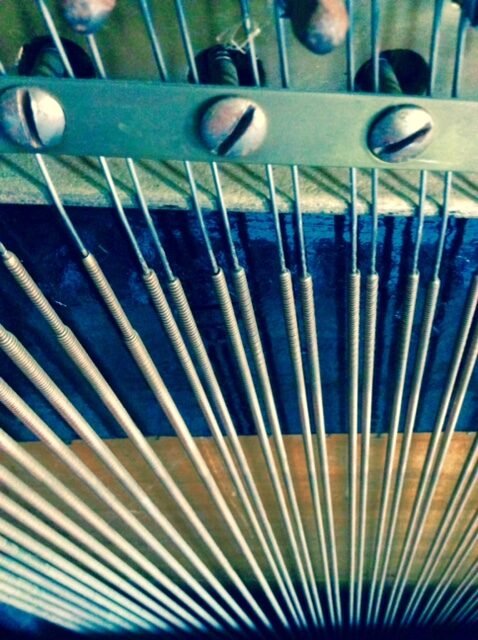
I started playing the piano at the age of ten. Very quickly, my curiosity shifted from the instrument to what was happening inside it. One day I took the piano apart to see how it worked and to understand how sound was produced. The strings, their tension, their arrangement and the different ways of setting them vibrating particularly caught my attention. I plucked them, rubbed them, struck them, discovering that sound could be explored beyond the keyboard and the pianist’s traditional gesture.
This early relationship with sound developed alongside an informal practice of dance, theatre and painting. These experiences gradually shaped a cross-disciplinary way of looking at and thinking about creation. Very early on, the different art forms appeared to me as languages capable of answering and transforming one another.
Between 1995 and 2000, my piano practice focused on technical mastery: scales, arpeggios, finger independence, precision of gesture and weight. This training gave me a precise understanding of the relationship between body, gesture and sound production. At the same time, performing the repertoire confronted me with another dimension of music-making: listening. I gradually understood that technical mastery was not an end in itself, but should allow greater openness to what happens in the sound, in the body and in the space.
I then pursued this line of thought through musicology, up to a research Master’s in which I focused on free improvised music. This research strengthened a concern that still runs through my practice today: how can one build a sound language while remaining open to what happens? The question of musical language — how it is built and how it transforms — became a central thread of my path.
My sound design work grew out of this continuity. Since 2010 I have worked with theatre, dance and circus companies and with visual artists. These contexts have gradually shifted the way I think about composition. I do not see sound as an autonomous material simply added to an existing work, but as a language built in relation to other art forms.
In live performance, I work as a composer but also as a musical dramaturg, often from the very first stages of creation. Together with directors, choreographers and performers, I look for ways in which sound and music can take part in writing a piece: how they converse with a moving body, a voice, a space. In this collaborative process I constantly have to sculpt the sound material so that it can resonate with the other media. The musical language is transformed through contact with each project.
This constant transformation does not mean an absence of method or framework. On the contrary, my practice relies on close attention to the matter, texture, densities and inner dynamics of sound. Repetition, minimalist forms and gradual variation hold an important place in my writing. They establish a time for listening and allow one to enter the sound gradually, perceiving it as living, organic matter rather than as a mere vehicle for melody or rhythm.
Economy of means is part of the same search. For me it is a compositional method rather than an aesthetic preference. Reducing the number of elements, leaving space, working from a single material or a gradual transformation makes perceptible phenomena that disappear when buried under an accumulation of sound. Micro-events, silences, tensions, variations in density and accidents become compositional elements in their own right.
Yet I do not try to impose the same style or aesthetic signature from one project to the next. I would rather start from a dialogue with the place of creation and with my collaborators. This attention leads to open, evolving forms that leave room for the unpredictable. Composition then becomes less the making of a definitive sound object than a way of organising the conditions for listening.
This approach matters especially in my in situ work, installations and performances. I am interested in how sound acts on the perception of a space, and how a place can in turn transform the way a sound is heard. Spatialisation, the acoustic character of an architecture, the movements of the body and the relationships between sound sources become structural elements of the composition.
This practice has been built through constant dialogue with other disciplines, but also with sound materials themselves. I use concrete sounds, field recordings, environmental, mechanical or organic sounds, as well as electronic materials to which I apply electroacoustic processes. The voice also plays an important role, sometimes detached from its verbal function to become matter, rhythm, texture or presence. It is always about questioning what sound can produce through its own qualities, before even trying to give it meaning.
This attention to listening also runs through my teaching. I develop projects and workshops on sound creation, active listening and soundscapes with many kinds of audiences. Here again, the aim is not only to pass on knowledge or techniques, but to enable everyone to develop the ability to listen, experiment and build their own language.
Listening then becomes a tool for relationship: listening to an environment, to someone speaking, to another participant, to a sound material, but also learning to recognise what emerges in a collective process. Testimony, traces and memory can become starting points for a creation. Sound practices can converse with the body, images or words, in a cross-disciplinary approach that extends the way I built my own relationship to creation.
Creation and teaching are thus two complementary dimensions of my practice. In both, I start from listening to build a relationship: with a sound, a body, a space, a person or a group. My work seeks less to impose a form than to create the conditions in which a form can appear, transform and enter into dialogue with its surroundings. The sound language stays in motion, nourished by contexts, encounters and the properties of the material itself.
It is in this space between construction and openness, composition and listening, mastery and the unexpected that my artistic practice is situated today.